
ASEAN in Focus: Pushing ahead
25 June 2026
Key takeaways
-
ASEAN’s economies are facing multiple shocks, from a brewing El Niño to US tariff uncertainty…
-
…yet activity is set to prove surprisingly resilient, supported in parts of the region by surging demand for AI hardware.
-
Rising price pressures are posing a risk, as do growing budget deficits, but growth should continue to trot along.
Indonesia’s economic performance remains stronger that market sentiment suggests, with a policy pivot underway to strengthen confidence. Thailand has seen investment bounce of late, but the lift in growth may not prove durable. Malaysia is riding the AI wave, but a possible election could sap reform efforts. The Philippines suffers from a surge in prices and fiscal inaction, even if its fundamentals remain solid. Vietnam harbours ambitions for more, even if growth is already at an impressive pace given energy and tariff headwinds. Singapore remains its resilient self, chugging along with relative ease, and taking a growing share of the AI boom.
Economy profiles
Key upcoming events
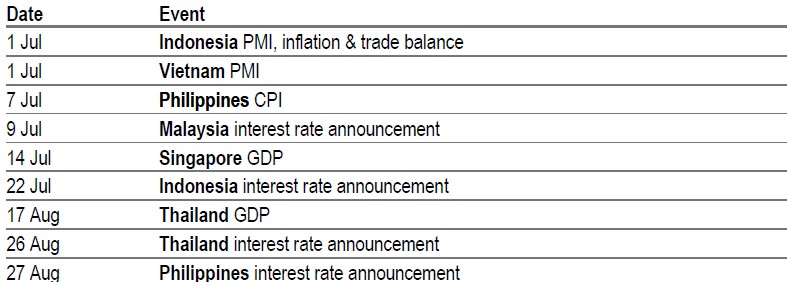
Source: LSEG Eikon, HSBC
Indonesia
Market strain, policy pivot
There is much attention on Indonesia lately. Across the major asset classes - equities, bonds and FX - Indonesia has underperformed the broad Emerging Markets (EM) index YTD. A cursory glance suggests that even though markets have not performed too well, the economy is chugging along fine. GDP rose 5.6% in the quarter ending March, higher than the 5.1% growth in 2025. And even though inflation has risen, it remains well within the 2.5-3.5% range.
A deeper review, however, suggests that the economy has started to gradually reflect the impact of the energy shock, and markets may be partly reflecting that. On growth, the latest readings show a fall in retail spending, consumer sentiment and export orders. There has been a significant amount of frontloading in fiscal expenditure, and belts may need to tighten in subsequent months to meet the 3% fiscal cap. We forecast GDP to grow 4.7% y-o-y in 2026 (versus 5.1% in 2025).
PMI input prices have risen quickly and are gradually pushing up output prices. We forecast inflation to average 3.5% in 2026 (versus 1.9% in 2025). The latest trade data shows a fall in the monthly surplus, with export volumes falling even as import volumes shot up. Meanwhile capital inflows remain sluggish, weighing on the exchange rate.
Supply shocks such as rising energy costs and adverse weather are always tricky to deal with because they come with trade-off. Generally, inflation rises and growth falls during these shocks. Often, policymakers have to choose between the two.
Some observers may see the Indonesian rupiah (IDR) as the primary challenge to address. The underlying driver of the IDR’s depreciation seems to be the balance of payments, which is likely to post its second negative annual reading in 2026. It’s tempting to argue that Indonesia does not face a current account problem, given the modest shortfall of -0.1% of GDP in 2025, and that the bigger concern is weak capital inflows, which came in at -0.3% of GDP in 2025. But, in practice, these two factors are interlinked. A low current account deficit can reflect subdued investment demand. Indeed, we find that corporates are cash rich but reluctant to invest. And weak investment and growth prospects can hurt capital inflows.
Indonesia’s persistent negative output gap
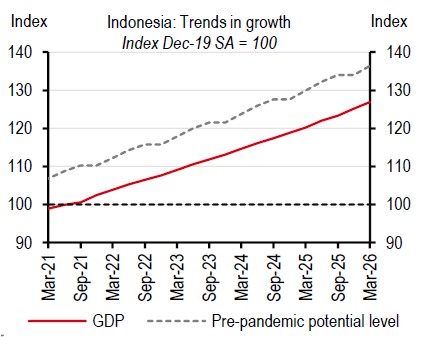
Source: CEIC, HSBC
Price pressures are rising
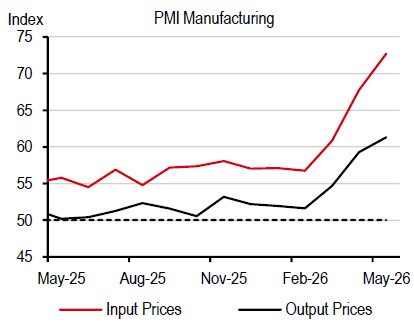
Source: CEIC, HSBC
Malaysia
Resilience is a virtue
Until the Middle East conflict, the Malaysian economy was in a “Goldilocks” stage, with strong growth and stable inflation. But the conflict increases the possibility of downside risks to growth and upside risks to inflation, even if Malaysia has demonstrated more resilience than regional peers, as it is not only a net energy exporter, but also a key beneficiary of the sustained AI cycle. This is not to say that Malaysia will be insulated from the energy shock, but the impact should be smaller than for other economies, which are heavily dependent on energy imports from the Gulf.
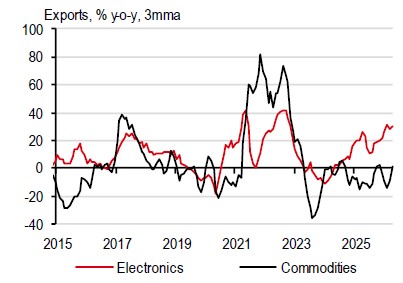
Malaysia has made a strong start to the year, with GDP up 5.4% y-o-y in 1Q26. While construction cooled from double-digit to single-digit growth, the sustained strength in manufacturing and services has more than offset the moderation. Exports remain strong, thanks to the ongoing AI-driven tech cycle. On a 3-month moving average basis, Malaysia’s electronics exports surged to 30% y-o-y.
Elsewhere, inflation has been well-behaved for a sustained period of time, averaging only 1.7% y-o-y in the first four months of 2026. This gives Malaysia one of the lowest inflation prints in ASEAN, significantly lower than peers like the Philippines and Vietnam.
In the face of elevated energy prices, it is not hard to understand why: Malaysia is blessed with the region’s lowest petrol prices. Using the most common RON95 price as a gauge, Malaysia’s RON95 remains at MYR1.99/l (USD0.5/l), 1/10 of that in Hong Kong, 1/5 of Singapore, 1/3 of Thailand and 1/2 of Vietnam. However, this is primarily due to heavy subsidies: RON95 at the market rate, or the unsubsidised rate, is twice that of the subsidised price.
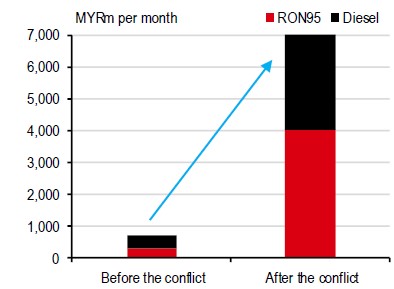
This comes with significant fiscal costs. The monthly subsidy bill for energy has risen tenfold from MYR700m to MYR7bn due to the conflict. The hefty subsidies raise questions on what comes next for the RON95 policy, as it imposes huge pressures on Malaysia’s fiscal coffers. But the timing of any potential adjustments is also tricky, as the general election is approaching fast.
Overall, we maintain our GDP growth forecasts at 4.5% for 2026 and 4.7% for 2027. Bank Negara Malaysia (BNM) is one of the few Asian central banks to raise its 2026 growth forecast range, increasing it from 4-4.5% to 4-5%. On inflation, we recently revised upwards our inflation forecast to 2.5% (from 2.1%) for 2026, and to 2.7% (from 2.3%) for 2027. However, we do not believe the price pressures are significant enough to prompt BNM to hike. We keep our long-held view that BNM will likely stay on hold in our forecast horizon throughout 2027.
Malaysia has been benefitting handsomely from the sustained AI-driven tech cycle
Source: CEIC, HSBC
Its petrol subsidy skyrocketed ten-fold to MYR7bn per month after the conflict
Source: Malaysia MoF, HSBC
Philippines
Hanging in there
Stagflation appears to be emerging in the Philippines. For one, growth continues to sour. In 1Q26, growth came in at 2.8% y-o-y, stumbling to its slowest pace since 2009, excluding the COVID-19 pandemic. The culprits of the slowdown remain the same: public capital disbursements continue to fall at a significant rate while the uncertainty around public spending has led to households and businesses pulling back on their expenditures. Savings are up, and investment is down.
Understandably so – households can weather tough times by putting aside a larger portion of their incomes during good times. That good time was 2025, when wages grew 7% on average while inflation was only 1.7%. However, instead of enjoying the increase in purchasing power by spending more, households chose to save. The share of households reporting that they were able to save before the energy shock in March 2026 was even higher than pre-pandemic levels, with the more vulnerable, low-income households leading the increase.
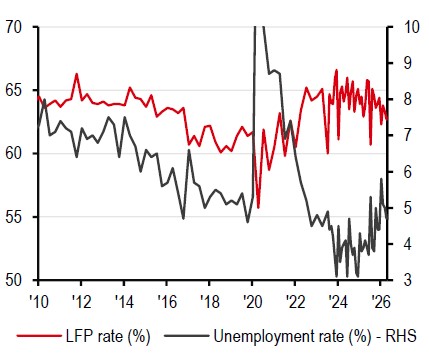
Unfortunately, this slowdown in demand has already spilled over to the labour market. The unemployment rate in the Philippines has risen above 5%. And soon, households and small businesses may need to dip into the savings they have recently accumulated.
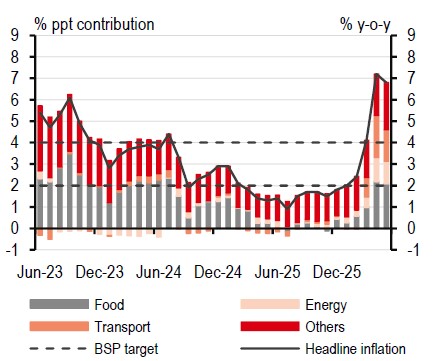
This is because prices continue to rise amid slow growth. Currently at 6.8% y-o-y, headline inflation in the Philippines is the highest in the ASEAN region. The surge in energy prices has already spilled over into core CPI, with core inflation accelerating above the central bank’s 2-4% target band. However, the outlook is set to become tougher, with price pressures on food − due to higher fertilizer prices and El Niño − expected to intensify in the coming months. We expect growth to come in well below potential in 2026 and 2027, at 3.4% and 4.8%, respectively.
But the Philippines is hanging in there. Once the energy shock normalises, financial markets in the Philippines are likely to recover quickly. This is because the fiscal response has remained prudent, as officials opted for targeted welfare measures. In addition, a healthy degree of “demand destruction” should eventually come to the fore. Without controls, energy prices in the Philippines have reflected the true scarcity of commodities. Growth may be below potential, but once the dust settles, public debt and the current account is likely to remain manageable and resilient.
With construction demand falling, the labour market has tightened…
Source: CEIC, HSBC
…all while inflation in the Philippines is rising across all major categories
Source: Macrobond, HSBC
Singapore
Treading with prudence
Singapore, a developed market (DM) growing like an emerging market (EM), has demonstrated impressive resilience amid the Middle East conflict. In 1Q26, GDP growth of 6% has placed it as the second-fastest growing economy in ASEAN, just after Vietnam. But beyond the strong y-o-y print, Singapore’s growth momentum was equally strong, reflecting the benefits of a diversified economy.
Alas, manufacturing momentum declined in 1Q, but it was more of a healthy pull-down from previous sustained manufacturing strength, supported by the AI-driven tech upcycle. In fact, based on high frequency indicators, the electronics trade remains exceptionally strong. On a three-month moving average basis in April, electronics non-oil domestic exports (NODX) accelerated to over 60% y-o-y, pushing headline NODX close to 15% y-o-y.
But it’s not only about AI. Singapore’s resilience comes from its broad-based growth. For one, the construction sector saw growth of over 11% y-o-y in 1Q, reflecting Singapore’s push for large-scale public infrastructure. Meanwhile, the services sector also accelerated on a y-o-y basis, benefitting from robust wholesale and retail trade as well as the finance sector.
There is no time for complacency, as downside risks to growth linger, induced by the energy shock. Singapore is in a much better fiscal position than EM peers to provide much-needed relief but it takes a cautious and measured attitude. Overall, given the upside surprise in 1Q26 and the sustained AI cycle, we recently upgraded our growth forecast to 3.3% (from 2.9%) for 2026, putting it at the upper end of the government’s growth forecast range of 2-4%. We forecast 2027 growth of 2.5%.
Outside of growth, inflation has been well-behaved, despite the energy shock. Core inflation, the Monetary Authority of Singapore (MAS) preferred inflation gauge, grew only 1.4% y-o-y on average in the first four months of 2026. But the impact from higher oil prices is likely to be more evident from 3Q26, as there is usually a quarter lag from global energy prices to core inflation. Thus, the inflation impact will be more evident in 2H26.
We also upgraded our core inflation forecast to 2.0% (from 1.8%) but revised down our headline inflation forecast to 2.2% (from 2.4%) for 2026. No doubt, inflation has re-emerged as a priority for the MAS. Given the current inflation trajectory, the MAS is more likely to take its time to assess the inflation impact, rather than resorting to a back-to-back tightening move in July.
Singapore’s electronics non-oil domestic exports (NODX) have seen a jump in growth
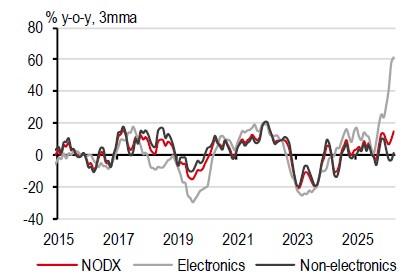
Source: CEIC, HSBC
Singapore’s core inflation momentum has been volatile, but upside risks linger
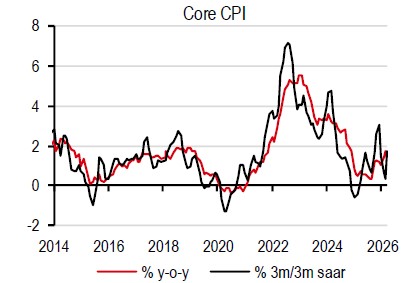
Source: CEIC, HSBC
Thailand
Policy clockwork
Thailand’s economy had some degree of momentum before fuel prices spiked on 23 March 2026, the day the government lifted its price ceilings on fuel. Growth in 1Q26 exceeded expectations, accelerating to 2.8% y-o-y despite the turmoil in the Middle East. Sectors and industries that are part of the data centre and AI supply chains were particularly buoyant. Goods exports from Thailand surged 15.5% y-o-y − the fastest since exports boomed during the COVID-19 lockdowns – with most of the outperformance seen in electronics. Thailand is a major producer of printed circuit boards and hard disk drives, two of the many types of hardware that make up the sophistication of a data centre.
Private investment, too, grew by double digits as some of the digital investments committed over the past two years (most being AI-related) finally materialised. Business confidence, especially among large firms, was upbeat as Thailand garnered a renewed sense of political stability after the February 2026 general election. Private consumption also remained punchy with consumers frontloading their automobile purchases ahead of the expiry of the EV 3.0 subsidy scheme.
We expect the economy to ride this momentum through fiscal policy. The government has issued a THB400bn loan decree (2.1% of GDP), half of which will be used to finance consumer subsidies. The other half will be used to finance Thailand’s energy transition. Given the size of the stimulus, we have recently revised our 2026 growth forecast to 2.2% (from 1.6%).
Will the Thai economy defy the challenges brought by the Middle East conflict?
There are cracks that need to be monitored. For one, manufacturers that do not benefit from the ongoing AI boom still face intense competition from Chinese imports. Private consumption should also slow once the consumer subsidies are wound up, while households continue to face liquidity constraints. As a result, businesses have found it difficult to raise the prices of the goods and services they sell despite the jump in input costs. With profit margins squeezed, there is likely to be less incentive to invest later in the year and into the next.
Overall, the growth outlook has improved in 2026, but 2027 is likely to remain tough. We recently revised our 2027 growth forecast downwards to 1.7% (from 2.6%). And, given the difficulty in passing higher costs on to consumers, we expect inflation to ease back to below 2% y-o-y as early as 2Q27.
Firms have found it difficult to pass the higher cost of inputs on to consumers
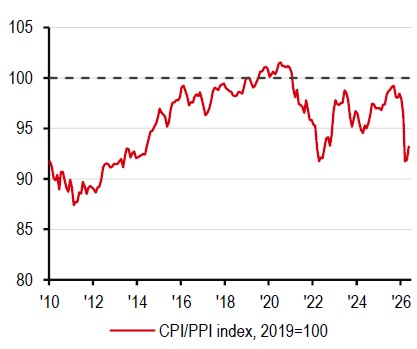
Source: Macrobond, HSBC
We expect fiscal policy to tighten in 2027 after a decade of widening deficits
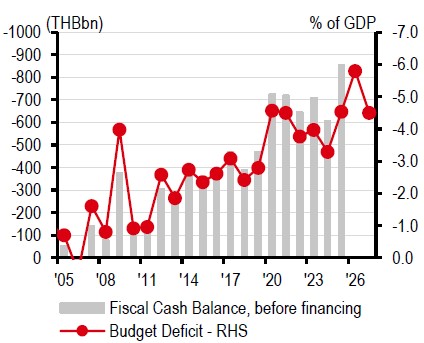
Note: *2026-27 are HSBC forecasts. Source: CEIC, HSBC
Vietnam
No room for complacency
Vietnam entered 2026 on a resilient footing. Despite moderating from last year’s 8%, the country saw rather decent growth of 7.8% y-o-y in 1Q26. This easily made Vietnam sustain its position as one of Asia’s fast-growing economies. However, there is no time for complacency, as the Middle East conflict has pushed up energy prices to elevated levels.
Nevertheless, a detailed look at trade data shows Vietnam’s trade resilience. Exports jumped almost 20% y-o-y YTD on average, thanks to booming electronics shipments. While Vietnam’s exposure to chips is rather limited, it has captured more market share in consumer electronics; not to mention that it has the ambition to climb up the value chain, seeing vast potential from its young, knowledge-hungry and tech-savvy workforce.
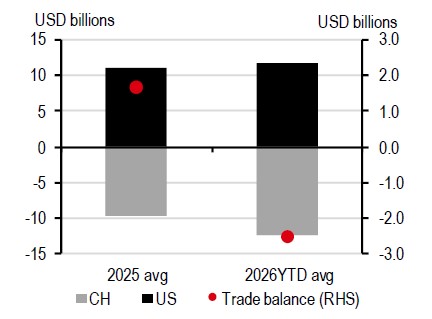
Despite booming exports, Vietnam’s imports grew even more, rising 30% y-o-y YTD. This is also understandable, to an extent, as Vietnam’s manufacturing sector is rather import-intensive. However, this raises a question about its trade balance. Since December 2025, Vietnam has consistently run a trade deficit, which widened to a record level of USD5.2bn in May. We do not think Vietnam will enter a “twin deficit” situation, as the tourism receipts and secondary income will help. However, we have revised down our current account surplus forecast to 2.2% of GDP, from 6% earlier, for 2026. This could pose depreciation pressure on the Vietnamese dong, which has been holding up surprisingly well compared to others since the start of 2026.
Overall, we forecast GDP growth of 6.5% for both 2026 and 2027. But downside risks are picking up, and depend on how the Middle East conflict evolves. The immediate concern for Vietnam is how to grapple with elevated oil prices. History reminds us of the acute impact of high oil prices in 2022: high oil prices pushed up Vietnam’s inflation, breaching its 4% ceiling for a little less than six months.
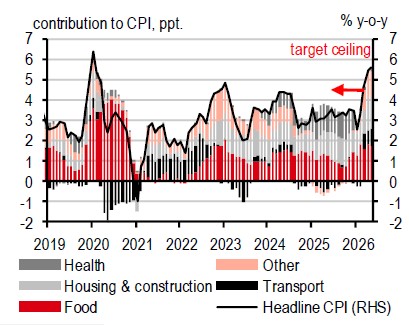
Fast forward to today, Vietnam’s inflation rose sharply to 5.6% in May, breaching the State Bank of Vietnam (SBV)’s 4.5% inflation ceiling for the third month running. While the significant jump in petrol prices was the main culprit, it is important not to ignore the recent hike in food prices. Although Vietnam is a rice exporter, its domestic rice prices are typically influenced by international prices. Overall, we recently revised up our inflation forecast to 5.2% (from 4.6%) for 2026.
Vietnam has consistently seen a trade deficit since the start of 2026
Source: CEIC, HSBC
Vietnam’s inflation has breached the central bank’s 4.5% target since March
Source: CEIC, HSBC


Related Insights


Disclosure appendix
Additional disclosures
1. This report is dated as at 24 June 2026.
2. All market data included in this report are dated as at close 23 June 2026, unless a different date and/or a specific time of day is indicated in the report.
3. HSBC has procedures in place to identify and manage any potential conflicts of interest that arise in connection with its Research business. HSBC's analysts and its other staff who are involved in the preparation and dissemination of Research operate and have a management reporting line independent of HSBC's Investment Banking business. Information Barrier procedures are in place between the Investment Banking, Principal Trading, and Research businesses to ensure that any confidential and/or price sensitive information is handled in an appropriate manner.
4. You are not permitted to use, for reference, any data in this document for the purpose of (i) determining the interest payable, or other sums due, under loan agreements or under other financial contracts or instruments, (ii) determining the price at which a financial instrument may be bought or sold or traded or redeemed, or the value of a financial instrument, and/or (iii) measuring the performance of a financial instrument or of an investment fund.
Disclaimer
This document is prepared by The Hongkong and Shanghai Banking Corporation Limited (‘HBAP’), 1 Queen’s Road Central, Hong Kong. HBAP is incorporated in Hong Kong and is part of the HSBC Group. This document is distributed by HSBC Continental Europe, HBAP, HSBC Bank (Singapore) Limited, HSBC Bank (Taiwan) Limited, HSBC Bank Malaysia Berhad (198401015221 (127776- V))/HSBC Amanah Malaysia Berhad (200801006421 (807705-X)), The Hongkong and Shanghai Banking Corporation Limited, India (HSBC India), HSBC Bank Middle East Limited, HSBC UK Bank plc, HSBC Bank plc, Jersey Branch, and HSBC Bank plc, Guernsey Branch, HSBC Private Bank (Suisse) SA, HSBC Private Bank (Suisse) SA DIFC Branch, , HSBC Financial Services (Lebanon) SAL, HSBC Private banking (Luxembourg) SA, and The Hongkong and Shanghai Banking Corporation Limited (collectively, the “Distributors”) to their respective clients. This document is for general circulation and information purposes only. This document is not prepared with any particular customers or purposes in mind and does not take into account any investment objectives, financial situation or personal circumstances or needs of any particular customer. HBAP has prepared this document based on publicly available information at the time of preparation from sources it believes to be reliable but it has not independently verified such information. The contents of this document are subject to change without notice. HBAP and the Distributors are not responsible for any loss, damage or other consequences of any kind that you may incur or suffer as a result of, arising from or relating to your use of or reliance on this document. HBAP and the Distributors give no guarantee, representation or warranty as to the accuracy, timeliness or completeness of this document. This document is not investment advice or recommendation nor is it intended to sell investments or services or solicit purchases or subscriptions for them. You should not use or rely on this document in making any investment decision. HBAP and the Distributors are not responsible for such use or reliance by you. You should consult your professional advisor in your jurisdiction if you have any questions regarding the contents of this document. You should not reproduce or further distribute the contents of this document to any person or entity, whether in whole or in part, for any purpose. This document may not be distributed to any jurisdiction where its distribution is unlawful.
The following statement is only applicable to HSBC Bank (Taiwan) Limited with regard to how the publication is distributed to its customers: HSBC Bank (Taiwan) Limited (“the Bank”) shall fulfill the fiduciary duty act as a reasonable person once in exercising offering/conducting ordinary care in offering trust services/business. However, the Bank disclaims any guaranty on the management or operation performance of the trust business.
The following statement is only applicable to by HSBC Bank Australia with regard to how the publication is distributed to its customers: This document is distributed by HSBC Bank Australia Limited ABN 48 006 434 162, AFSL/ACL 232595 (HBAU). HBAP has a Sydney Branch ARBN 117 925 970 AFSL 301737.The statements contained in this document are general in nature and do not constitute investment research or a recommendation, or a statement of opinion (financial product advice) to buy or sell investments. This document has not taken into account your personal objectives, financial situation and needs. Because of that, before acting on the document you should consider its appropriateness to you, with regard to your objectives, financial situation, and needs.
Important Information about the Hongkong and Shanghai Banking Corporation Limited, India (“HSBC India”)
HSBC India is a branch of The Hongkong and Shanghai Banking Corporation Limited. HSBC India does not distribute or refer investment products to those persons who are either the citizens or residents of United States of America (USA), Canada or any other jurisdiction where such distribution or referral would be contrary to law or regulation. HSBC India is an AMFI-registered Mutual Fund Distributor and an AMFI-registered Specialized Investment Fund (SIF) Distributor. HSBC India distributes select mutual fund schemes and SIF strategies of empanelled Asset Management Companies, and acts as a referrer of other third-party investment products.
Mutual Fund investments are subject to market risks, read all scheme-related documents carefully
AMFI-registered Mutual Fund Distributor | Date of Initial Registration: 19th Feb-2002 | ARN-0022 I Validity of ARN: 18th Feb- 2027
AMFI-registered SIF Distributor I Date of initial registration: 27th Oct 2025 | ARN-0022 I Validity of ARN : 26th Oct 2028
HSBC India will receive commission from HSBC Asset Management (India) Private Limited, in its capacity as a AMFI registered mutual fund distributor of HSBC Mutual Fund. The Sponsor of HSBC Mutual Fund is HSBC Securities and Capital Markets (India) Private Limited (HSCI), a member of the HSBC Group. Please note that HSBC India and the Sponsor being part of the HSBC Group, may give rise to real, perceived, or potential conflicts of interest. HSBC India has a policy in place to identify, prevent and manage such conflict of interest
For more information related to investments in the securities market, please visit the SEBI Investor Website: https://investor.sebi.gov.in/ and the SEBI Saa₹thi Mobile App. Mutual Fund investments are subject to market risks, read all scheme related documents carefully.
Issued by The Hongkong and Shanghai Banking Corporation Limited India . Incorporated in Hong Kong SAR with limited liability.
Singapore
In Singapore, this document:
• has not been reviewed by any regulatory authority in Singapore or any other jurisdiction.
• is issued by HSBC Bank (Singapore) Limited (the "Bank") in the conduct of its business in Singapore and is for general information.
• is only meant for the person who received it and should not be copied or shared with others, either fully or partially, for any reason.
• must not be sent to the United States, Canada or Australia or to any other jurisdiction where sharing it is illegal. If someone uses or copies this document or video without permission, they could face legal action.
• gives a broad overview of the current economic environment and is not meant to be investment research or advice or a recommendation to buy or sell investments. Some parts might talk about future events, but these are just predictions and not promises nor guarantees of future performance or events. Actual results might turn out differently due to various reasons. The Bank is not responsible for updating these predictions or explaining why actual results could differ from those predictions.
• does not create any contracts and isn’t meant as a solicitation, nor a recommendation for the purchase or sale of any financial instrument in any jurisdiction where it is not legal. Investments can increase or decrease in value, and you might not get back the amount you initially invested. Investments come with market risks, so it is important to read all investment-related documents carefully. The opinions shared are from the HSBC Global Investment Committee at the time of creating this document or video and reflect its global perspective, which might differ from local views of the Bank. These opinions can change anytime and might not match HSBC Asset Management‘s current portfolios’ composition. HSBC Asset Management manages individual portfolios based on each client’s objectives, risk preferences, time horizon, and market conditions.
• has not been created following legal requirements for independent investment research and is not subject to any prohibition on dealing ahead of its dissemination.
• is not meant to offer accounting, legal or tax advice. Before making any investment decision, consider consulting a financial adviser. If you decide not to seek advice, carefully assess if the investment product is suitable for you. It is recommended to obtain appropriate professional advice when needed.
Investing overseas can lead to changes in the value of your investments due to currency exchange rates, which may cause them to rise or fall. Emerging markets are riskier and more unpredictable compared to established markets. These economies often depend heavily on international trade and can be adversely impacted by trade barriers, currency controls, adjustments in currency values, the economic conditions of their trading partners and other protective measures imposed by those partners.
We are not responsible for the accuracy and/or completeness of any third-party information obtained from sources we believe to be reliable but have not independently verified.
Mainland China
In mainland China, this document is distributed by HSBC Bank (China) Company Limited (“HBCN”) to its customers for general reference only. This document is not, and is not intended to be, for the purpose of providing securities and futures investment advisory services or financial information services, or promoting or selling any wealth management product. This document provides all content and information solely on an "as-is/as-available" basis. You SHOULD consult your own professional adviser if you have any questions regarding this document.
The material contained in this document is for general information purposes only and does not constitute investment research or advice or a recommendation to buy or sell investments. Some of the statements contained in this document may be considered forward looking statements which provide current expectations or forecasts of future events. Such forward looking statements are not guarantees of future performance or events and involve risks and uncertainties. Actual results may differ materially from those described in such forward-looking statements as a result of various factors. HSBC India does not undertake any obligation to update the forward-looking statements contained herein, or to update the reasons why actual results could differ from those projected in the forward-looking statements. Investments are subject to market risk, read all investment related documents carefully.
Should you wish to use AI technology (computational, statistical, machine-learning or other artificial intelligence techniques to infer or learn from data to find patterns, take actions, make decisions, or generate output) to help you analyse, summarise or evaluate this publication and/or any other research materials provided to you by HSBC, you shall seek HSBC consent in advance of any such use and not upload this publication and/or any other research materials produced by HSBC to an AI system or otherwise use AI technology in connection with the research services HSBC provides to you without our consent.
© Copyright 2026. The Hongkong and Shanghai Banking Corporation Limited, ALL RIGHTS RESERVED. No part of this document may be reproduced, stored in a retrieval system, or transmitted, on any form or by any means, electronic, mechanical, photocopying, recording or otherwise, without the prior written permission of The Hongkong and Shanghai Banking Corporation Limited.
Important information on sustainable investing
“Sustainable investments” include investment approaches or instruments which consider environmental, social, governance and/or other sustainability factors (collectively, “sustainability”) to varying degrees. Certain instruments we include within this category may be in the process of changing to deliver sustainability outcomes.
There is no guarantee that sustainable investments will produce returns similar to those which don’t consider these factors. Sustainable investments may diverge from traditional market benchmarks. In addition, there is no standard definition of, or measurement criteria for sustainable investments, or the impact of sustainable investments (“sustainability impact”). Sustainable investment and sustainability impact measurement criteria are (a) highly subjective and (b) may vary significantly across and within sectors.
HSBC may rely on measurement criteria devised and/or reported by third party providers or issuers. HSBC does not always conduct its own specific due diligence in relation to measurement criteria. There is no guarantee: (a) that the nature of the sustainability impact or measurement criteria of an investment will be aligned with any particular investor’s sustainability goals; or (b) that the stated level or target level of sustainability impact will be achieved.
Sustainable investing is an evolving area and new regulations may come into effect which may affect how an investment is categorised or labelled. An investment which is considered to fulfil sustainable criteria today may not meet those criteria at some point in the future.